
One Step Ahead in Marine Surveillance
All over the world Governments are having to face up to the challenge posed by smugglers, poachers, illegal immigrants and criminals who use the cover of darkness to carry out their activities along the coastline. This threat might include terrorist incursion and drug-running as well as the wider aspects of exclusive economic zone protection.
As those who pose the threat adopt more sophisticated means of avoiding detection, so coastguards, navies and other official agencies have an operational need to ensure that their surveillance capability is always one step ahead.
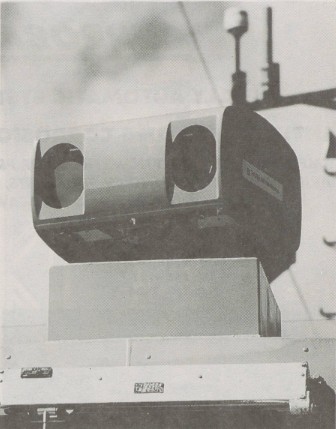
One company among the many in Britain that have been studying this requirement for a number of years has now combined the latest lightweight thermal imager technology with a highly capable lowlight TV camera to produce a stabilised dual sensor system. Orders have already been received from British and Norwegian customers.
The Marine Electro Optical Surveillance System (MEOSS) has been developed by THORN EMI Electronics, working closely with McLennan Marine, to produce a system that can be fitted to a wide range of craft operating in open seas and inshore waters. The two sensors are mounted on a remotely-controlled stabilised tracking head which weighs only 50 kg in total. A compact display unit is fitted inside the vessel and can also have a "slaved" display available to the helmsman to assist in night navigation when the vessel is moving at speed.
There is an interface with the craft's gyrocompass and radar. As well as coastal patrol work this type of equipment is well suited to search and rescue operations following a shipping or aircraft accident, where survivors may be scattered amongst floating debris of all shapes and sizes, and where waves might also make visual contact difficult.
SUSPICIOUS ACTIVITY
A system such as this provides the drew with a 24-hour night vision and poor weather capability, making it possible to identify a boat at a range of over 7.5 km or an individual in the water at 1.5 km range. Suspicious activity, even when carried out in total darkness, can be observed with considerable picture clarity and information such as date, time and position can be recorded with the pictures for future examination.
The surveillance operation uses passive equipment and so those under observation will be unaware that they are being watched and recorded. In some cases illegal operators have been known to fit radar warning receivers to their vessels to their vessels to detect coast- guard patrols, but such precautions will be ineffective against a craft equipped with a joint thermal imaging- /low light TV system.
It is the introduction of compact, lightweight thermal imagers, originally designed for army use as portable battlefield night sights, which has enabled such a system to be built for general use aboard small vessels. The small size, weight and modest power requirements are particularly important on this type of boat.
INFRA-RED WAVELENGTHS
Detectors need to be sensitive to temperatures at infra-red wavelengths to detect in the dark and for this a wave band that has a high transmission level is required to enable distant objects to be identified. Because the temperature differences in a thermal imaging scene are often just fractions of a degree, detectors have to be used that generate signals proportional to the incoming infra-red, and these signals are ac coupled to the amplifying electronics.
In this way it is only the signal variations that are processed. An artificial dc level is added at a later stage to regain dc restoration. Then the available contrast can be amplified over the dynamic range of the display. Contrast expansion requires a good signal- to-noise ratio and noise in the detector normally determines the lower limit of the smallest detectable temperature difference. If the operating temperature of the detector can be lowered than the background noise is reduced and performance improved.
TECHNOLOGY BREAKTHROUGH
Work on thermal imagers dates back to the 1960s but it was not until the late 1970s that a technology breakthrough occurred in detector materials which permitted the development of a suite of thermal imaging common modules that have formed the basis for today's range of products. Continuous development of detectors, with improvements to scanning and cooling capabilities and electronic processing, has resulted in great strides in miniaturisation becoming possible. Even more ultra-compact imagers, designed on a modular basis and featuring electric or air bottle cooling and a wide choice of magnifications, have made it possible to exploit the technology in a range of different applications.
Apart from direct view hand-held thermal imagers, which are completely self contained, indirect viewing versions are available and can be run from batteries or external power sources. Police forces and paramilitary operators are finding them invaluable for detection of people in difficult terrain and in poor visibility, and armies now make widespread use of thermal imagers to detect targets against a camouflaged background. (Thermal imagers can see through fog and smoke because the infra-red wavelengths pass undisturbed through these elements which would otherwise block visible wavelengths.)
EFFECTIVE OPERATIONS
For those engaged in covert surveillance and border observation, the compact thermal imager has greatly increased the effectiveness of operations. Detection of objects or people in undergrowth, behind bushes or floating on water is made possible because of the difference in temperature between the subject and its surroundings. By identifying the thermal signature of objects it is possible to recognise specific items of equipment, including vehicles, even though they might have been hidden very thoroughly from normal vision. It is very difficult to camouflage people and vehicles against thermal imaging detectors.
More recently, lightweight thermal imagers have been developed for use as passive aircraft detection and alerting devices on the battlefield, or mounted on armoured vehicles, and can be integrated with short-range air defence missile systems to enhance detection and sighting performance.
Now, by adapting the technology for small ship use, a whole new market is opening up, offering customs and coastguard operators the performance quality that was previously only available to navies at much higher cost, and aboard much larger vessels. Thermal imaging seems well placed to help maintain surveillance superiority for those engaged in the fight for maritime sovereignty.