
Asia’s cleaner shipping push slowed by RE shortfall
Without green power, e‑fuel output remains limited.
The Asia‑Pacific (APAC) region’s push to cut shipping emissions is being held back by limited renewable energy and scarce green hydrogen.
Without enough clean power to run electrolyzers, production of e‑fuels such as green methanol remains small. That limits their role in a sector that needs large, steady volumes of fuel.
E‑fuels are often framed as part of a bio or electric pathway, Liu Ming, research director at Nanyang Technological University’s Maritime Energy and Sustainable Development Centre of Excellence, told Marine & Industrial Report.
“But they actually represent a convergence of the two,” he said in an emailed reply to questions. That intersection, he added, depends on renewable power that is still unevenly available across APAC.
The region is increasingly viewed as a testing ground for e-fuels such as green methanol. Pilot projects are spreading across ports and shipping lanes, whilst governments and industry groups are backing early infrastructure and green‑corridor plans.
Few of these efforts, though, have moved beyond demonstration scale. A study by Accelleron Ltd. described the region as an emerging hub for cleaner shipping fuels whilst flagging a large gap between pilots and commercial deployment.
Infrastructure constraints, limited clean power supply, and weak demand signals remain key barriers.
Bio‑based fuels face fewer obstacles. Liu described them as “ambient liquids” that can be used with minimal changes to existing ships and fuel systems. That makes them the most practical option for near‑term emission cuts.
It also highlights a broader imbalance. Feedstocks may be available, but the renewable energy needed to scale next‑generation fuels is not.
Methanol and ammonia are the most advanced alternatives after biofuels and have been tested across production, storage and vessel operations. But volumes remain small, and availability is uneven across the region.
Cost remains a central issue. “The green premium remains a hurdle,” Torben Norgaard, chief technology and analytics officer at the Maersk Mc‑Kinney Moller Center for Zero Carbon Shipping, said in an emailed reply to questions.
He noted that customers are reluctant to absorb higher fuel costs without stronger policy support.
Regulation is expected to shape how fast the gap narrows. Carbon pricing across much of Asia remains limited, whilst demand‑side incentives lag behind Europe, weakening the business case for large‑scale fuel investment.
Global rules are adding pressure. The International Maritime Organization’s Net Zero Framework and the EU’s FuelEU Maritime are forcing shipowners to plan for lower emissions. Regional policy alignment, however, remains uneven.
Operational readiness is another challenge, with many mid‑ and smaller‑sized vessel owners lacking experience with new fuels, safety systems and fuel procurement models.
Capabilities need to be built across the value chain, Norgaard said. Collaboration is growing through port initiatives, government‑backed infrastructure projects, and industry platforms.
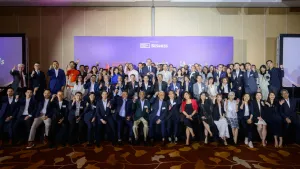
Norgaard and Liu were amongst the speakers at the Asia-Pacific Maritime forum in Singapore in March where stakeholders exchanged insights and discussed alternative fuel deployment.
Knowledge-sharing, Norgaard said, would be critical to lower costs and scale supply.
Even so, without faster renewable build‑out and cheaper green hydrogen, e‑fuels will remain limited in a region that carries much of the world’s trade.