
Korean Register, Hyundai Samho complete hull safety programme
It calculates loads and buoyancy after changes in hull weight and trim.
The Korean Register (KR) and HD Hyundai Samho have developed a program enabling rapid assessment of hull structural safety during partial launching in the shipbuilding process.
This follows an eight-month joint development project, titled “Automated Structural Analysis Program for Partial Launching Conditions Based on Direct Strength Analysis,” which began in February 2026.
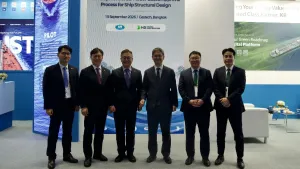
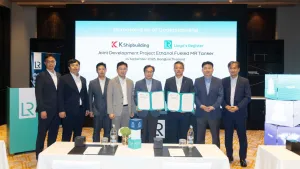
KR presented HD Hyundai Samho with a project completion certificate at Gastech 2026 in Bangkok on 14 September.
Under the project, HD Hyundai Samho provided the data required for program development, including partial launching scenarios and load conditions based on actual shipbuilding operations.
KR developed functions based on Direct Strength Analysis to assess the loads acting on the hull and evaluate its structural strength and safety.
HD Hyundai Samho subsequently applied the program to an actual vessel to verify its practical applicability in the field.
KR described partial launching as a shipbuilding method in which a vessel is launched before construction is fully completed, with the remaining work carried out afterwards.
This allows shipyards to make more efficient use of dock capacity and provides greater flexibility in construction schedules.
It added that the hull’s weight and buoyancy distribution can differ from that of the completed vessel because hull blocks or certain structures may not yet be installed.
“This requires a close review of structural safety to confirm the hull can safely withstand the loads generated during launching,” KR said.
The review process was time-consuming as engineers had to build a separate structural analysis model excluding structures not yet installed at the time of partial launching and recalculate the resulting changes in loads and buoyancy.
The newly developed program automates this process, accounting for structures that are not yet installed or connected and generating an analysis model corresponding to the vessel’s actual construction status at the time of partial launching.
It also automatically calculates loads and buoyancy considering changes in hull weight and trim, enabling structural safety assessments to be carried out more quickly and efficiently.
“We expect this program to shorten the time required for structural safety reviews during partial launching and provide greater flexibility in dock operations and shipbuilding schedules,” said Hakmu Shim, Executive Vice President of HD Hyundai Samho.
The two companies plan to expand the scope of the newly developed assessment program to a wider range of ship types and partial launching scenarios, and to continue upgrading its capabilities for stability prediction and flexible response across different launching conditions.