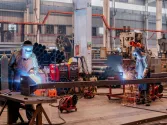

Chinese shipyards extend global lead with 69% of 2025 orders
China also held 66.8% of the worldwide orderbook heading into the next decade.
Chinese shipyards secured 107.82 million deadweight tonnes (dwt) of new ship orders in 2025, equivalent to around 69% of global contracting activity, according to the Xinhua-Baltic International Shipping Centre Development Index Report 2026.
The report added that Chinese shipyards completed 53.69 million dwt during the year, equivalent to 56.1% of global output, whilst the country’s orderbook reached 274.42 million dwt, accounting for 66.8% of the global total.
“Chinese yards have now led the world across all three key industry indicators—completions, new orders, and orderbook size—for more than a decade,” it noted.
South Korea remained the second-largest shipbuilding nation, capturing around 20% of global orders in 2025, with its shipyards maintaining a strong presence in technically complex vessel types, including liquefied natural gas (LNG) carriers and large gas tankers.
Japan ranked third, with shipyards continuing to specialise in bulk carriers and niche vessel segments where operational efficiency and construction quality remain competitive advantages.
Together, China, South Korea, and Japan account for most global shipbuilding capacity, reinforcing Asia's position in new vessel construction, the report said.
The global orderbook reflects the increase in newbuilding activity that began in 2021 and accelerated through 2023 and 2024 as shipowners responded to strong freight markets, rising fleet utilisation, and the need to modernise ageing fleets.
“By 2025, the result was a historically strong orderbook stretching well into the second half of the decade,” the report said.
Lead times at major shipyards now extend three to four years for many vessel types, whilst delivery slots for some specialised vessels—including LNG carriers and large container ships—are sold out until the end of the decade.
The report said the backlog gives shipbuilders clearer projections of future workloads but leaves shipowners facing longer delivery times, higher construction costs, and stronger competition for available yard capacity.
New ship orders slowed in 2025 compared with the previous two years amidst uncertainty in freight markets, tighter financing conditions, and ongoing questions around the energy transition.
The report also said uncertainty over future fuel regulations has prompted many shipowners to order vessels with dual-fuel capability or designs that allow future conversion.
“Methanol-ready and ammonia-ready designs have become increasingly common as shipowners attempt to maintain flexibility whilst regulatory frameworks continue to evolve,” it added.
Environmental regulation has become a key factor in newbuilding decisions, with the report citing stricter emissions targets alongside regional measures such as the European Union's Emissions Trading System and FuelEU Maritime rules.
“In practice, shipowners are now effectively ordering ships for a regulatory future that is still taking shape,” it said.