
Exports - the Key to UK Boatbuilding Recovery
There is little doubt that following several years of tough economic struggle, general - if tentative - signs of economic recovery in all areas of industry in the UK are now being felt.
Matters have been harder to swallow perhaps because recession followed such a forceful economic boom in the late 1980s, after which the leisure industry was hit particularly hard.
The Marine Industry Statistics Report for 1993, issued by the British Marine Industries Federation (BMIF), estimated the UK's total marine industry turnover at around 956 million pound - around 13% up on 1992.
The greatest reliable increase can be attributed to equipment manufacturers and levels of UK manufactured boats, engines and equipment now exported all run in excess of 50%. Export has become the key to recovery.
The pace is undoubtedly set by the electronics manufacturers (many headquartered outside the UK) and the boatbuilders. The latter have, however, suffered most at the smaller end, especially where traditional export markets to Germany, Italy and Spain have taken a slide.
BRIGHT SPOT
The bright spot appears amongst those who worked hard on increasing export sales on a worldwide basis before recession hit and, in so doing, unwittingly prepared a cushion. In the powerboat sector, for example, the following approximately export figures apply amongst the leading builders: Marine Projects (85%), Sunseeker International (99- %), Fairline Boats (90%) and Sealine (85%). Luxury catamaran builder Prout, which sold the first four of its new Panther 61s to Middle East customers, appears so dedicated to export sales that company price lists are all in United States dollars.
Sunseeker's staggering export figure (to an extent a reflection of the British public's preference for a mooring in a Mediterranean marina rather than an indication that so few boats are sold to UK buyers) has earned the company three Queen's Awards for Export, the third awarded just last year. Export and a change in company philosophy - "to build bigger boats of a higher value for a smaller market" - has, says marketing manager Jeremy Gee, helped the company to ride the recession.
CONTINUAL PROGRAMME
Last year the company estimates that it would build 240 boats and achieve a turnover in excess of 42 million pound. Gee says, "We have a continual boat development programme so that we can release new models every year and we place great importance on liaising direct with customers to make sure they get exactly what they want."
Fairline Boats, the UK's only stock-ex- change-listed boatbuilder, revealed results for the half year to March 31st 1994 when "the company earned a profit before tax of 350.000 pound in the first half of our financial year, more than double our profits of 161.000 pound for the same period in 1993." The latest figures reflect the company's huge success at 1993's London Boat Show when its UK Distributor B A Peters took more than 7 million pound in orders.
Company chairman Sam Newington reports that in April 1994 the company had 15% more cash in customer deposits than at the same time in 1993, with an outstanding order book 50% higher than for 1993. Ever strengthening sales in the Far East and Middle East as well as core export sales to Germany have caused direct export sales to increase to 70% but Newington added,"Taking account of indirect exports by our UK distributors we estimate that we are selling approximately 90% of our total output abroad."
SETTING SIGHTS
Top of the range builder, Oyster Marine, less affected perhaps than any other by the recession, is setting its sights on the London Boat Show in 1995 for the launch of a new 61-ft model, and revealing new interior styling for all boats in the range in celebration of the company's 21st birthday.
But is the recession over? Marketing manager David Blacklaws hesitated, "Our boats - at an average sales value of 500,000 pound - are not bought by the man of the street. The reaction we are getting now is 'Come back in three months time' - this hopefully is a sign that the recession is lifting but the real proof is six months away."
Now building 15-20 boats per annum and exporting 60-70%, Oyster (another recipient of a Queen's Award for Export in 1990) has adopted a philosophy for success that is identical to that of Sunseeker. Blacklaws added, "Ten years ago we built 30-40 boats per year but they were smaller in size and mostly for the UK market. By changing our outlook in 1988 towards better quality bigger boats we may have masked the recession."
SUCCESSFUL COMPANIES
Production sailing cruiser builder Westerly Victoria, the amalgamation of two successful marine companies in 1993, is, however, up on sales but down on exports. Managing Director Peter Gregory explained, "The UK sector started to turn around at the Southampton Boat Show in 1993 where we sold 40 boats compared with 23 in 1992." He remained confident of selling around 120 boats a year for leisure purposes.
Unlike most other UK leisure builders (Prout being another exception) Westerly Victoria is also strong in the commercial sector, having maintained Victoria's established relations with the UK Ministry of Defence.
A smaller range of workboats and rigid inflatables has also been developed and an Asian agent appointed. Gregory takes export possibilities very seriously, "It is important to stress that our core business is boatbuilding not yacht building. The commercial market is a lot less volatile and the market growth for small fast boats is huge."
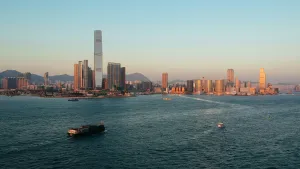
A similar approach is notable amongst the largest of the UK's commercial boatbuilders - Halmatic and FBM Marine. The latter, working on a 42 million pound order for seven of its high-tech Tricat multihull ferries for its parent company in Hong Kong, clinched a further order for four monohull ferries for a Portuguese operator. The contract won by EC competitive tender is set to keep the yard in work for two years.
BRISK BUSINESS
Halmatic, builders of GRP multi-role workboats, also reports "brisk business during 1994." In 1995, the company anticipates growing interest, especially designs in particular. Although UK sales are very strong, the past year has seen plenty of overseas orders to countries.
Quality and variety are seen to be the biggest recession beaters and to achieve this Halmatic now boasts the largest product range of any European boatbuilder and has won international renown for the standard of its newbuild.