Korean OCCS proposal becomes basis for IMO safety guidelines
Framework covers storage, leaks, emergency response, and carbon offloading.
A Korean public-private partnership’s (PPP) proposal has been selected as the basis for developing the International Maritime Organisation's (IMO) interim safety guidelines for onboard carbon capture and storage systems (OCCS).
At the IMO’s 12th session of the Sub-Committee on Carriage of Cargoes and Containers (CCC 12), the working group agreed to use the Korean partnership’s proposal as the basis for developing the interim OCCS safety guidelines.
The proposal incorporates elements of a separate submission from the International Association of Classification Societies (IACS).
Korea will coordinate the Correspondence Group on GHG Safety, which will develop the guidelines ahead of CCC 13 in 2027. Joonghun Kim from Korean Register’s (KR) Convention & Legislation Service Team was named coordinator of the group.
“Shipowners need standards covering safe operation, maintenance, and offloading, not capture performance alone,” said Youngsun Kim, Senior Vice President, Director of Technology & Innovation Institute at HMM. “It was important to be able to reflect actual operating conditions from an early stage of international guideline development.”
Established in April 2026, the PPP comprises 10 maritime organisations led by Korea’s Ministry of Oceans and Fisheries, with KR overseeing regulatory development.
Its members include HMM, Samsung Heavy Industries, Hanwha Ocean, HD Korea Shipbuilding & Offshore Engineering, Hyundai Heavy Industries Power Systems, HI Air Korea, PANASIA, and the Korea Research Institute of Ships & Ocean Engineering.
The proposal builds on Korea’s multi-year OCCS development work, including raising safety concerns about the location of onboard carbon dioxide storage tanks in 2023 and proposing initial safety guidelines in 2024.
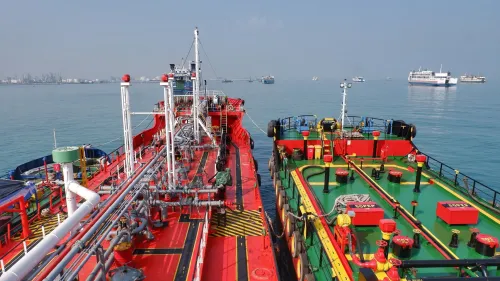
It also draws on technical assessments and operational experience associated with HMM Mongla, which was fitted with an OCCS solution in 2024 as part of a joint project involving HMM, Samsung Heavy Industries, PANASIA, and KR.
Ongoing risk assessments based on the vessel’s OCCS design identified 64 hazard scenarios, helping to inform the development of practical shipboard safety requirements.
“Safety functions must be capable of being tested and verified in the field,” said Jeongsu Seo, Executive Director at HI AIR KOREA, adding that the experience could be linked to leak detection and emergency shutdown requirements to contribute to practical safety standards.
The proposed guidelines cover safety considerations including carbon dioxide handling and storage, leakage prevention, emergency response, and the safe transfer of captured carbon ashore.
These requirements are intended to address the capture equipment itself, alongside its interaction with other onboard systems and day-to-day vessel operations.
The framework retains a technology-neutral main body, covering common safety requirements and separate annexes addressing hazards specific to different OCCS technologies.
This approach allows different capture methods, including chemical absorption, membrane separation and mineralisation, to be considered without favouring a particular technology, whilst enabling requirements to evolve as further evidence becomes available.
The Correspondence Group will bring together contributions from IMO Member States and international organisations and report its progress to CCC 13 in 2027.
Finalisation and approval of the interim guidelines will be subject to further consideration by the IMO.
“The practical experience, knowledge and expertise of the entire 10-member partnership have led to an important milestone in the development of OCCS safety standards at an IMO level,” said Kyung-bok Kim, Executive Vice President of KR.