Union Maritime’s wind-assisted tanker targets 4.5-tonne daily fuel savings
Three rigid aerofoil sails equip the 114,000-DWT Aframax product tanker.
Union Maritime’s 114,000-deadweight-tonne wind-assisted Aframax product tanker ALBERT PARK could save up to 4.5 tonnes of fuel daily using three rigid aerofoil sails, cutting carbon dioxide emissions by an estimated 14.1 tonnes under favourable conditions.
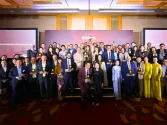
Built by Yangzhou COSCO Shipping Heavy Industry and classified by Bureau Veritas (BV), the vessel was officially named in September.
It is the first wind-assisted Aframax product tanker built by Yangzhou COSCO Shipping Heavy Industry and incorporates three WindWings aerofoil sails designed by UK-based BAR Technologies.
Each sail measures 37.5 metres in height and spans 19.7 metres, providing a combined sail area of 738 square metres.
The system harnesses wind energy to generate additional forward thrust, reducing the load on the vessel’s main engine and lowering fuel consumption.
Its three-element aerofoil design comprises a main wing and adjustable flaps, with the sails automatically optimising their angle of attack in response to changing wind conditions.
The WindWings technology has received both Approval in Principle and Design Type Approval from BV.
BV awarded the vessel the WIND PROPULSION-1 class notation, confirming compliance with its requirements for the safe integration and operation of wind propulsion systems.
It also received the CLEANSHIP, GREEN PASSPORT, EGCS-SCRUBBER, ERS-S, and BWT notations, covering areas including pollution prevention, emissions control, ballast water treatment, and waste management.
“The classification of ALBERT PARK highlights the value of collaboration across the maritime value chain in accelerating the deployment of practical decarbonisation solutions,” said Jeffrey Guo, Marine & Offshore Asia Pacific Senior Vice President at BV.
BV provided classification expertise, technical guidance, and verification services throughout the vessel’s design and construction to support the integration of its wind propulsion system.